I’m serious, it was $3.00. There may have been a small sales tax, though.
Let’s face it, being a writing student is hard. You decide to go to a university to fuel your passion for writing and probably make it your career. You love to write—maybe that’s the only passion you know for certain—and getting to learn about it, talk about it, and do it for assignments is a dream come true, isn’t it?
But this vision of grandeur quickly falls apart when you’re in the back of a lecture hall learning about astronomy for one of your gen-ed requirements, and you have simply no idea why you’re there when you only want to write. It falls even further when you find that writing for a class is not nearly as satiating as when you wrote for yourself. You discover working and writing for the mystified academia takes up so much of not just your brain power, but your writing power too.
When you have a moment of free time amidst this, your first thought probably isn’t to write for yourself, either. The yearning to “college” the right way—get nothing done at study sessions with your friends, go to events around campus that are too good to pass up, order pizza at 1:00 in the morning—often take up the rest of what little brain power you have left, and why wouldn’t it? The hard truth your university does not tell you before you commit to your creative area of passion is this: It can be extremely difficult to do what you love all the time.
It’s tough to swallow, that’s for sure, and much tougher to try and combat. Some students quickly face creative burnout; for others, the love they held for their passion might turn into resentment. There are dozens of diagnoses for why this issue persists, and dozens more potential cures for those diagnoses, but I’m not here to prescribe you a cure-all; I’m here to tell you what has worked for me.
I relate a lot to what Helen Molesworth says in her book Open Questions: Thirty Years of Writing about Art: “I did not feel the calling that some writers have felt; I did not have hypergraphia. I was not burning with a compulsion to write.” Instead, she says, she wrote to figure things out—to come to terms with what confused or bothered her, how she felt about the world. This is how I’ve approached my writing, both in a professional and creative sense, my entire life, even if I didn’t always know that was what I was doing. I write to understand.
When you’re young, there are thousands of thoughts and questions for you to understand, so you write. You write because the answers you find shave some weight off the tons of questions hurting your back; you write because it feels so good to know something for once. Then when you become an adult, you realize you don’t know much of anything, and really, you’ll never know exactly what to do all the time. I’ve slowly become more comfortable with this epiphany, but my writing certainly faltered. I had lost my fuel, my passion. I could follow instructions, try to understand what I could, but honestly, I haven’t been proud of much of my work in a very long time.
This semester, however, I’m enrolled in a course titled “Art Thinking,” where—surprise!—we think about art, a lot. We read about how to view art, but we also practice viewing art and listening to how it provokes us. I’ve never cared much for visual art (I am a writing major, after all), but this class has opened my lens to it, which has been new and exciting for me. All this to say, I waltzed into a Goodwill recently, and I figured I ought to look through their art section.
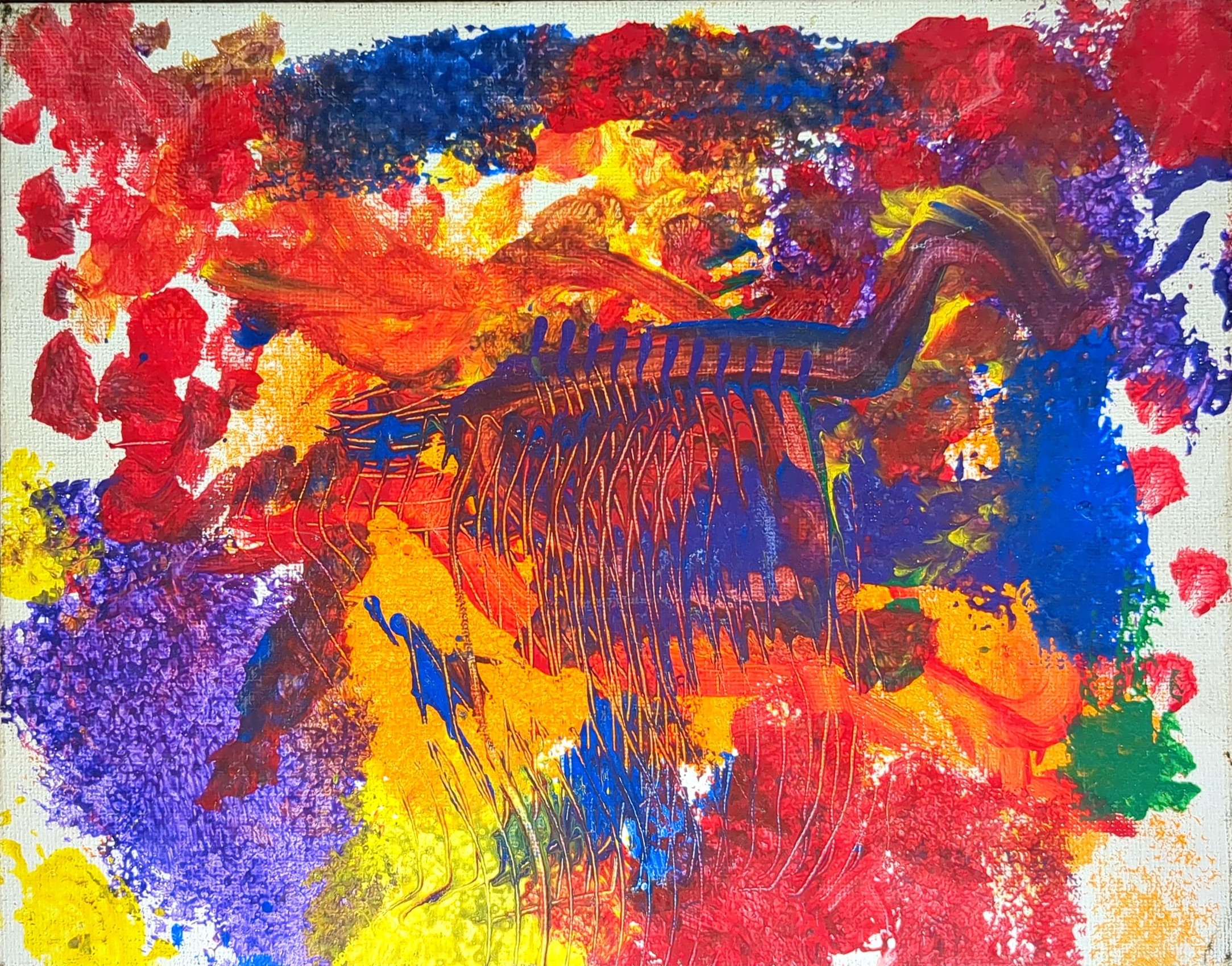
It was there I found a hand-painted canvas riddled with colors and textures, made by a toddler circa 2009. I didn’t know what to make of it at first. There is so much depth to it, it overwhelmed me to look at it, to feel what it did to me. It was listed at $3.00, so I bought it, and now I’m simply enamored by it.
Looking at it from an artist’s perspective, I have no idea how its technique works. I think the toddler used a fork to create its ridged lines, but that’s about it. I don’t know much about color theory and why there are so many colors there, and why I enjoy them together. I don’t really think any of that is the point. The artist who created this painting wasn’t thinking about any of that; they followed a feeling, what their heart told them to do and what their hand could allow. Maybe that was what I was sensing: The artist poured overwhelming feeling into this piece, and it became all I could see. It became my passion for the painting.
As students and young writers, often we write only to understand and find answers to our questions, which can be incredibly fulfilling until the answers run out. Instead, I propose writing to understand feelings. After all, we can’t know the right answer to many questions, but we can know how we feel about them.
I did this by looking at artwork, and you can do this too. Go to an art exhibit and bring a journal to write in; listen to a song or read a good book. Maybe, instead, this looks like going to a park, walking in nature, or sitting by a river or a pond. Whatever you do, don’t write about what you think about it—write about how it moves you, what you understand about your feelings at that moment. I think you will find the words come pretty quickly.