
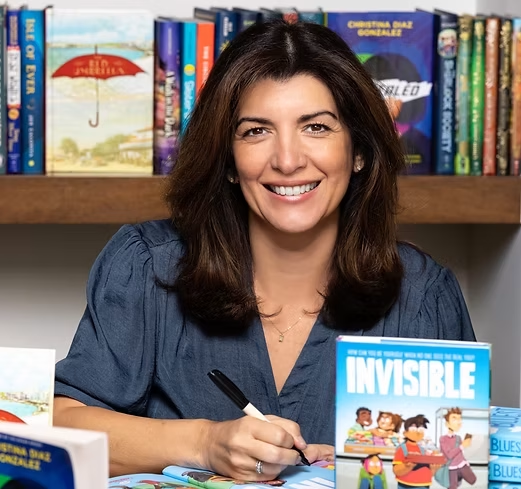
Christina Diaz Gonzalez is the Edgar Award-winning and USA TODAY best-selling author of eight books including The Red Umbrella, Concealed, Invisible: A Graphic Novel, and the upcoming graphic novel, Offside. Her books have been named to over thirty-two state award lists and have reached international acclaim with nominations for Japan’s Sakura Medal and several International Latino Book Award wins. She currently lives with her family in Miami, Florida.
Author Origins
Johanna Zamora (JZ): You have a background as a lawyer, so writing was a second career for you. On your website’s “About Me” page, you mention that watching your sons fall in love with reading reignited your passion for writing. What was it like returning to that passion and being able to share it with your sons?
Christina Diaz Gonzalez (CDG): It was a slow process. I watched my oldest son fall deeply in love with books at a young age. At that time, I had fallen away from books, so I wasn’t reading that much. Seeing his excitement every time he got a new book, a new story, reignited something in me. It reminded me that I had stories to share. He was reading at a faster pace than I could get books, so I thought, wouldn’t it be wonderful if I wrote one of those stories? So I did. I remember him reading it off the computer when I was on the other side of the room. Then I heard him laugh, ’cause it was funny. I realized: how cool is it that my ideas and words can cause a reaction? That moment was the spark.
JZ: After that initial spark, did you take any writing classes as you made that transition, or did you do it all on your own?
CDG: I did not. In fact, I will admit that I’ve never taken a creative writing class in my life. But I did join a writer’s group. There were probably about 10 of us, and we would meet at a bookstore every week. We could bring in 10 pages of whatever we were working on, pass it around, and then read it out loud. That reading out loud helped catch so many mistakes that everyone was making. I would get their feedback, go back, revise. And that was my writing class. It was diving in, hands on with other writers.
JZ: How do your experiences as a lawyer, mother, and then, a member of a writing group shape your writing?
CDG: I think everyone’s experiences shape their writing. You bring to the table everything that you’ve experienced as a child, as a young adult, and as an adult. So, everything influences my writing. I take my experiences from when I was young and incorporate them into the memories and experiences of my characters. The precise writing of being a lawyer, the different writing styles of the people in my writing group, and the books I was reading all influenced my writing style.
Discussing Invisible, The Red Umbrella & A Thunderous Whisper : Writing Roots
Daniela Cruz (DC): Your story, Invisible, follows five Spanish speaking students, George, Sarah, Dayara, Nico, and Miguel, as they are forced to complete their school’s community service hours. You worked with Gabriela Epstein to create this graphic novel. Can you tell us a little bit about what that process was like?
CDG: I came up with the idea of writing a dual language, graphic novel. First, because I learned English in school, and still remember those moments of feeling lost and not understanding what was being said around me. Second, because I would visit classrooms where kids were learning English. All of their books were either entirely in English or entirely in Spanish. The only bilingual books were picture books, which aren’t engaging to older kids. It was really a very separate process. I wrote it and gave it to the publisher, then the publisher found the illustrator, and then the illustrator took my written words to create the illustration. It wasn’t really a collaboration; it was really two separate processes. In my new graphic novel, it’s a different illustrator, and she works a little differently. I’ve been able to see her sketches and she’s asked me for some feedback, but it really is a distinct process.
JZ: As an aspiring Latina writer, I wish I had more role models like you when I was growing up. How would you say your Cuban roots influence your writing?
CDG: My Cuban culture always influences everything I do. It’s just part of who I am, just like it’s always part of my stories. No matter what the story is, I like to incorporate my Latina culture and include even just a little something of Spanish. When I’m writing a book, I’m seeing the world through my character’s eyes, especially since most of my stories are from a first-person point of view. I’m putting myself in their shoes, and my shoes have Cuban roots.
JZ: How do visiting schools and talking with student readers impact your writing?
CDG: I love to get their feedback and see what really resonates with them, and I’ll use it for future writing. I also get ideas from them. Ten years after my first novel, The Red Umbrella, I wrote a follow-up book called The Bluest Sky. This came from a student who questioned if there was something else going on behind the scenes in The Red Umbrella, and if the events truly happened the way they did. It sparked the idea for a novel where maybe we only saw it from the main character’s perspective, but something else was happening.
DC: Why do you think it’s so important to have Latinx representation in YA literature specifically?
CDG: I think it’s important because that’s the world we live in. The Latino community is in the U.S. They’re a vital, vibrant part of our country and our world, and they deserve to be main characters in books. They deserve to be front and center. Their stories aren’t always those of overcoming, although stories of overcoming are important to have. I’ve written those too. Still, we also need everyday, fun, enjoyable stories, where the hero and the main character happen to be Latino, Latina, or another ethnicity, because we deserve to see each other as heroes.
DC: And do you think that, in the past 10-to-15 years, there has been more representation of Latinx stories, or less?
CDG: Well, statistics show that for a little bit, there was a slight bump, and when I say slight bump, we’re talking one or two percentage points, so it was still extremely underrepresented. It’s dipping down again, unfortunately. So, my hope is that as young readers start reading books that showcase the world around them as it really is, they also will be inspired to write about their own ethnicity, their own backgrounds, and highlight other people’s cultures as well.
DC: Your books take place in different historical time periods. The Red Umbrella, for example, takes place in 1961, two years after the Communist Revolution in Cuba. That story follows Lucia Alvarez, whose parents send her and her little brother to live in the United States for a better life. Another book, A Thunderous Whisper, takes place in Spain in 1936, at the start of the Spanish Civil War, and follows 12-year-old Annie and her friend Matthias who become messengers for the underground resistance movement. How do you decide to write about those time periods, and how do you make them accessible to younger audiences?
CDG: It comes down to inspiration and I never really know where inspiration is going to strike. The Red Umbrella is loosely based on my parents’ story of coming to the U.S. through Operation Pedro Pan, where 14,000 children, from infants to 17-year-olds, were sent to the U.S. This happened to my parents as well as to my mother-in-law, so it was a history I grew up hearing about within my community. That’s where that inspiration came from. A Thunderous Whisper came from art. It came from Pablo Picasso’s mural, called Guernica. It’s a testament to the atrocities of war and Hitler’s bombing of the city of Guernica, Spain, during the Spanish Civil War. Then I saw a picture of a woman wearing a black dress and holding a big basket with sardines in it. She had a very unhappy face, staring at the camera. I thought, was it tough to be the daughter of this bitter-looking woman? This led me to come up with a story of a young girl during that time. Her mother sells sardines, and she has to help her, so she smells like sardines. As a result, she’s bullied in school, and things start happening to her. The story just took over from there. But it really came from curiosity about things I didn’t know, so you never know where inspiration will find you.
On Writing Process
JZ: Going off of that, many of our readers of The Broken Plate are aspiring authors. Can you tell us a bit about your writing process?
CDG: I think it’s important to note that every writer has their own process. There is no right way to be a writer; you just have to find your own path. Mine is to allow a story to really spring up in my imagination. I get excited about it and I start thinking about it as a movie in my head. It develops into a movie trailer where I know the highlights of what’s going to happen and usually the ending. Then I sit down and dive in. I have no plan. I have no outline. I see myself simultaneously as the writer, and the first reader. So, as I’m writing, I’m trying to guess what’s gonna happen next. Do I want to agree with what I think is happening next, or is there going to be a twist? That’s how I approach writing.
JZ: Are there any writing rituals you swear by? Anything that really helps you get into that mental space?
CDG: An important writing ritual for me is to have dark chocolate nearby. If I feel like I’ve accomplished what I set out to do, whether writing 15 pages in one day, or just getting through two tough pages, I reward myself with a little bit of dark chocolate.
JZ: On the topic of things being tough, what is the most difficult part of the writing process for you, enough to where you need to reward yourself with dark chocolate?
CDG: I probably go through the most dark chocolate when I’m writing the middle of the story, because I don’t have a plan and I haven’t laid it out. I get very excited at the beginning, so I’m on a roll. I usually know where I’m headed because I know the ending, but then that murky middle pops up. It’s where little bouts of imposter syndrome come in, and I’m thinking, do I even know how to write? Or is this writer’s block? This is when I have to remind myself to just put words on the page. I’ll just have to, you know, power through with a little dark chocolate.
JZ: And then, lastly, what’s the most surprising part of the publishing process?
CDG: At the beginning, the most surprising part was how long it took. Once you think your draft is as perfect as it can be, your editor comes in and reminds you that, no, it still needs work. Editors at publishing houses are very busy, so they’ll take months to get back to you, then give you a very short window to turn it around. Once that’s done, and you really think it’s perfect, there’s still the process of copyediting. After that, sales, marketing, and art departments get involved. I was shocked at how much patience I had to have before the book actually came out.