
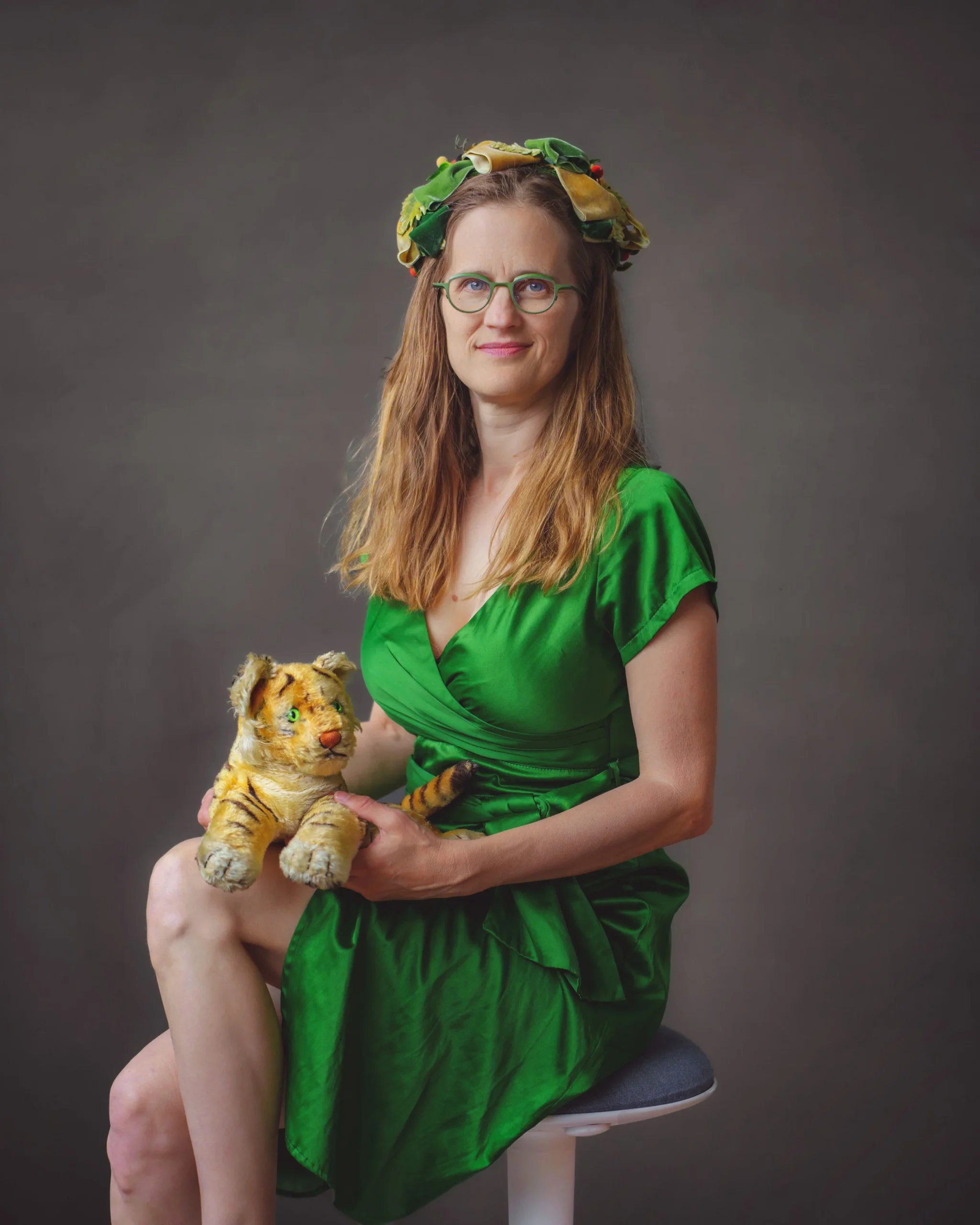
Once upon a time, Laura Stanfill lived in a New Jersey house filled with music boxes, street organs, and books. She grew up to become the publisher of Forest Avenue Press and the author of Singing Lessons for the Stylish Canary. Her short-form work has appeared in Shondaland, The Rumpus, Catapult, The Vincent Brothers Review, Santa Fe Writers Project, and several print anthologies. She believes in indie bookstores and wishes on them like stars from her home in Portland, Oregon, where she resides with her family and Waffles the dog.
From Writer to Editor
Ruth H. (RH): I just wanted to start off by talking about how you started your journey with Forest Avenue. I know that you started your career with a journalism background, and then you moved to creative writing and publishing later on, and then you went on to found Forest Avenue in 2012, where you publish Literary Fiction on a Joyride and the Occasional Memoir. The press won two publishing fellowships from Literary Arts, and Reedsy renamed it a Best Independent Press. What led you to become interested in literary editing in the publishing industry in the first place?
Laura Stanfill (LS): I’ve always been a writer. I have loved writing since second grade when I started wanting to be a writer. I got my English degree at Vassar College and then decided to go into journalism as a way to use language. And then in 2012, so flashing forward a bunch of years, I was burned out from journalism. To do community reporting the way I wanted to do was a lot of hours and a lot of going to council meetings and things. I just burned out, and so I decided to start a publishing house, because I was an unpublished writer, and I knew so many writers like me. So, it actually came about because Powell’s Books, our big flagship bookstore here in Portland had an Espresso Book Machine. And the idea was, like a cup of coffee, you could go in and ask for a book to be printed, and they would print it. And I thought, what a joyful, wonderful option to make a book inside a bookstore. So it was totally the DIY technology part that made me decide to make a book. And I fell in love with doing it, and that first book was a success. I mean, not a financial success, but because it costs so much to use the machine. Those machines had a lot of potential, but they didn’t really live up to it. So, eventually, I moved over into publishing single-author books, and occasional anthologies, and printing traditional print runs. But it started as just a project to see if I could learn about publishing from the inside, and then share it back with writers.
RH: That’s so awesome. I love the idea of just going in and printing a book any day. That’s fun.
LS: It was so cool. I used to say it was like a gumball machine, like, you put in the quarter, and then you turn the knob, and then you watch it all happen. But instead of watching the spiral of the gumball, you watch all the pages print, and then you watch the cover print, basically like a Xerox machine, you know, like a really good four-color printer. And then they would hold all the pieces together and cut it and then put some glue on the binding, and then bind it, and then it would pop out the chute as a hot, off-the-press book. It’s very cool.
Editing and Advocacy
RH: That is really cool! I want to just switch over a bit to the types of things you publish. In an interview with the Hub City Writers Project, you mention the importance of voice and advocacy for underrepresented voices. How do you ensure this advocacy as a part of Forest Avenue in terms of audience and potential contributors?
LS: It’s something I continue to grapple with, because the whole point is to reach writers who have stories that haven’t found their place in the world yet, and that match our aesthetic, and that we believe in. It was really hard at first, because it’s one thing to say, hey, we’re looking for historically marginalized voices, or underrepresented voices, or stories by people who haven’t had enough of their stories told before. But at the very beginning, with a really small catalog, we didn’t have books for writers to say, “Oh, they published a South Asian author with a similar book, but mine is different because it’s like this, and then they would submit to us.” That’s how we train writers to find editors or agents, is by looking to see what else they’ve done. So, it took a while to build out our catalog to show what we’re doing, and our increase of authors of color who are submitting has definitely been seen over the years. We also have gotten better at advertising or reaching out to communities more widely.
And then, of course, whenever we publish an author of color, if they have friends who are also authors of color they can recommend them, or they hear about the press through their friend. And I would say we’re more successful at this now than we were 5 or 10 years ago, for sure. Definitely authors of color are a huge priority for us, so are neurodivergent authors, and so are disabled authors and queer authors.
RH: To branch off of that representation idea a bit, how are small publications such as Forest Avenue uniquely situated in the publishing community? What are the benefits of being part of a smaller publication rather than a large house?
LS: Portland has been amazing to run a press in. When I first came here, there were some big-name authors, and I would go to all their events and feel like, oh, someday I want to be like them. And over time, and going to more events, I realized that there were small press publishers doing good work here. And there were a heck of a lot of authors who were unpublished, but still doing the work of writing, and therefore part of the literary community. So, in creating Forest Avenue Press, I created an entity that gave space and time to those unpublished writers.
Our first book was an anthology called Brave on the Page, and I basically opened it up to anybody I knew and their friends to write micro-essays about the craft of writing. And so that first book was 200 pages, but it had, like, 50 people in it. And the idea was to catch the folks who were sitting in the back of the room when the famous people were speaking, and say, you matter too, your stories matter, also your stories matter. So, for a long time, I was in a leadership role of bringing writers together, bringing presses together. I did a handful of events where I was trying to bring the community together. For example, a bunch of us did an ad in Publishers Weekly one time. All the Portland publishers who could afford it, and all the literary agents, anybody, and writing organizations, and we made this page and a half spread of all of our little icons essentially saying, “These are all the people in Portland.”
What actually makes space in the reviewing journal for all of us who wanted to participate, instead of just continuing to hammer on the fact that Tin House is here, for instance. As small presses, we get to do what we want. We get to set our own metrics and our own boundaries. If I end up with too many manuscripts, we don’t have to open for submissions for a while. I am not trying to replicate a book that sold millions of copies. And so, that means that I don’t really care about authors’ social media numbers in a way that agents and editors at the big New York houses do. I can afford to say yes to somebody who only is on Twitter, as much as we all hate Twitter now. My author, Daniel A. Olivas, when I signed him for Chicano Frankenstein, he was only on Twitter and he remains on Twitter, and because he’s there, Forest Avenue is there, and basically all I do is go into Twitter and retweet what he’s doing. But he’s built a great community of Latinx authors, editors, publishers and poets there, and people respond to his content regularly. He actually uses this platform that has gone down in flames to forward his voice as a Latino in the United States. And Chicano Frankenstein has sold a lot of copies, and he’s not on Facebook or Instagram at all, he’s on Twitter, and to me, that’s the magic.
I mean, an agent or an editor at a big house might have said no to this book, because he doesn’t have all the platforms. And for me, I didn’t care. I loved the book, and I felt like I could sell the book. And sure enough, we made a cover and a book description, and Chicano Frankenstein, people know what it’s about, or they can infer, and it just keeps selling, and college classes keep picking it up, because they’re looking for Latinx voices in, in horror, or monster stories, and they find Chicano Frankenstein, because they look up Frankenstein, and there it is.
So I think that’s really important, and it also means that we are not trying to find cookie-cutter bestsellers. We are trying to find books that surprise and delight. And I’ve had room to grow, too, because when I first started my press, we called it Quiet Novels for a Noisy World, which was great. But over time, my taste has become more genre-bending and playful, and especially at this time, where everything feels really hard and sad and scary out in the world, finding books that have some sort of playfulness or joy in them has become my mission. So that’s where Literary Fiction on a Joyride comes in, and most of our books fall into that in some way.
Stay tuned for Part 2 of this interview!