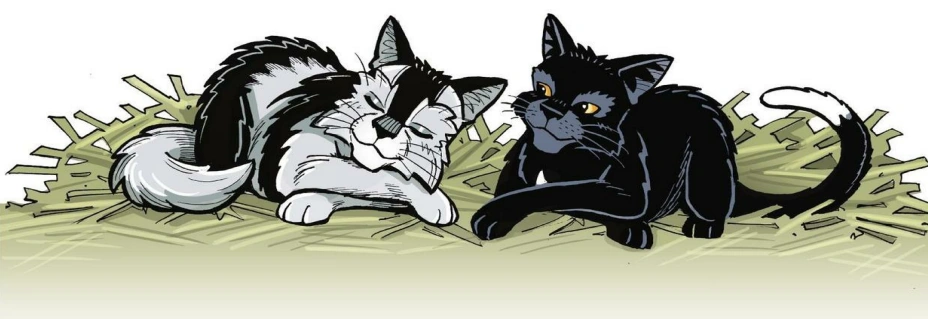
In the first arc of Erin Hunter’s Warriors series, Ravenpaw, a young, skittish cat and an apprentice in ThunderClan, is the sole witness to a treasonous murder. He must do whatever it takes to save not only his life, but also his reputation. So, what plan do his buddies come up with? It’s barn time for Ravenpaw. He lives away from ThunderClan with Barley, an older tomcat and distant ally to ThunderClan.
Throughout the first arc, Ravenpaw comes back to assist ThunderClan several times, including helping the Clan avoid conflict. He also fought alongside Barley, implying that the two had grown close, when he came back in the final book of the arc to help the Clans defeat Scourge, a bloodthirsty cat who tried to take over the forest with his gang of rogues. While Hunter never uses the word “mate” to describe their relationship, details point towards it being romantic. In other books, such as the novella Ravenpaw’s Farewell, Barley’s sister’s children ask if the two are ever going to have a litter of their own. At the end of the novella, Ravenpaw dies between Barley’s paws, promising him that he’ll see him again one day. When Ravenpaw passes, he refuses to go to StarClan (the afterlife of Clan cats) since he knows that Barley wouldn’t be allowed. Instead, he waits in an alternate afterlife for Barley. He also refuses a warrior name (a privilege given to Clan cats as a mark of coming of age and as a reward for finishing their training), as he has been Ravenpaw all his life, and he wants to be remembered as “Ravenpaw.” “But he was no longer an apprentice, no longer part of ThunderClan or the forest…‘Thank you,’ he purred. ‘But I already have a name. I am proud to have been Ravenpaw all my life, and I see no reason to change it now.’”1 Although he still carries the -paw suffix of an apprentice, Ravenpaw is a warrior, and his place is to walk beside Barley, forever and always.
Victoria Holmes, one of the “Erins” (the authors who write as Erin Hunter), even stated that Ravenpaw and Barley were supposed to be an openly gay couple, but “the books were written at a different time, when it was not possible to be open and honest about this kind of thing.”2 Since the first arc was published in the early 2000s, and Ravenpaw’s Farewell was published in 2016, it makes sense why the Erins were unable to write that the two were mates explicitly. Despite this, I felt that the Erins were able to portray Ravenpaw and Barley’s same-sex relationship well. Barley and Ravenpaw have one of the healthiest relationships in the series. And although one had to read between the lines to understand that the two were more than friends, they normalized queer relationships: they didn’t have to explain their partnership, it just felt right.
The Warriors series has been adapted into a graphic novel, in which Ravenpaw openly uses the word “mate” to describe his relationship to Barley. The two are also seen blushing at each other in various panels. In addition, the new super edition, StormClan’s Folly, features a prominent tomcat couple, one of whom is coded as bisexual due to his previous relationship with a female leader. Ravenpaw and Barley’s relationship was just the beginning, and now the whole series is more progressive and inclusive. In my opinion, the fact that the two characters are now getting fair representation marks a welcome change in children’s literature.
Footnotes:
[1] Erin Hunter, Ravenpaw’s Farewell, pg. 216 (epub)
[2]https://static.wikia.nocookie.net/warriors/images/e/e9/Vicky_book_fair_questions.screenshot.png/revision/latest/scale-to-width-down/1000?cb=20240609185340